

Insight & news /
Mansion House 2026: Rachel Reeves’ financial services legacy and what comes next
Against the backdrop of a change in Labour leadership and widespread expectation that Rachel Reeves’ time as Chancellor is drawing to a close, the 2026 Mansion House speech became as much about legacy as it was about new policy.
Reeves used the occasion to argue that the foundations for a more competitive, investment-focused financial services sector have already been laid and the next administration should continue to push progress on delivery.
While her wider economic record has attracted significant political debate, her impact on financial services has arguably been more substantial than is often recognised. Over the past two years, the Government has embarked on one of the most ambitious programmes of financial services reform since Brexit, spanning capital markets, pensions, banking regulation, digital assets and fintech. Last night’s announcements should therefore be viewed less as a new strategy and more as a continuation of an agenda already well underway.
Financial Services as a Growth Strategy
That ambition has been reflected across a wide-ranging programme of reforms designed to position financial services at the heart of the Government’s growth mission. The Financial Services Growth and Competitiveness Strategy and the Leeds Reforms placed growth alongside stability as a central objective for regulation, while reforms to bank capital requirements, ringfencing and capital markets have sought to unlock additional lending and investment across the economy.
Alongside this, the Government has continued to develop its approach to digital assets, tokenisation and stablecoins, signalling its ambition for the UK to remain a leading global financial centre. This week’s publication of the Government’s One Year On update to the Financial Services Growth and Competitiveness Strategy underlined that this is not a series of isolated policy announcements, but a coordinated programme of reform stretching across regulation, innovation and investment.
Payments and fintech have also become increasingly prominent. The publication of the National Payments Vision, continued progress towards the Open Banking Long-Term Regulatory Framework and work to establish the foundations for Open Finance demonstrate a clear intention to modernise the UK’s payments landscape while supporting greater competition and innovation. HM Treasury’s publication of their consultation on modernising payments regulation reinforces that direction, recognising that the regulatory framework must evolve alongside rapid technological change.
Pensions become economic policy
If there is one area that best illustrates Reeves’ approach, it is pensions.
Over the past two years, pensions policy has evolved from a debate about retirement savings into a central part of the Government’s growth agenda. The Pension Schemes Act, which received Royal Assent earlier this year, established a new legislative framework for the market, while this week’s Workplace Pensions Roadmap set out the next phase of implementation. Alongside the Value for Money reforms and the Pension Commission’s review into adequacy, the Government is seeking to encourage greater consolidation, improve member outcomes and unlock more long-term investment into productive UK assets.
These reforms represent the Government’s clearest attempt yet to reshape the workplace pensions market around scale, value and productive investment. These reforms build on earlier initiatives, including the Mansion House Accord, and demonstrate a consistent policy direction, which is use long-term pension capital to support economic growth while strengthening outcomes for savers. In doing so, Reeves has helped reposition pensions from a standalone retirement policy issue to a central pillar of the Government’s wider financial services and growth agenda.
Mansion House signals the next phase
This year’s Mansion House announcements largely built upon reforms already underway. The Chancellor confirmed further progress on digital financial markets, including the UK’s planned Digital Sovereign Bond and the next phase of the Great British Tokenised Deposit initiative. Alongside recommendations from the Transatlantic Taskforce on Markets of the Future, these measures reinforce the Government’s ambition to position the UK at the forefront of digital finance.
The publication of the Financial Services AI Adoption Plan, together with announcements on AI-enabled payments and wider support for innovation, reflects the Government’s belief that artificial intelligence will become a defining feature of future financial services. Alongside this, the publication of the Financial Services Skills Compact, consultations on payments regulation and wider regulatory reform demonstrate that the Government’s focus is increasingly shifting from setting the strategic direction to ensuring the sector has the regulatory framework, talent and infrastructure needed to deliver it.
The package of announcements also serves as a clear marker for the incoming administration. The next Chancellor will take on a programme of reform that is already well established. The decisions taken over the coming months are therefore likely to focus less on whether to pursue reform, and more on the pace, prioritisation and delivery of an agenda that is already in motion.
Conclusion
If this proves to be Reeves’ final Mansion House speech as Chancellor, it will likely to be remembered less for any single announcement than for the cumulative programme of reform it sought to defend. The policy direction is now largely established. Capital markets reforms are underway, pension reform is progressing, digital assets are moving towards implementation, and regulators continue to be tasked with supporting growth alongside financial stability.
The challenge for whoever succeeds Reeves is therefore unlikely to be designing a new financial services strategy. Instead, it will be delivering the reforms already in motion and demonstrating that they can translate into stronger investment, increased competitiveness and sustained economic growth.
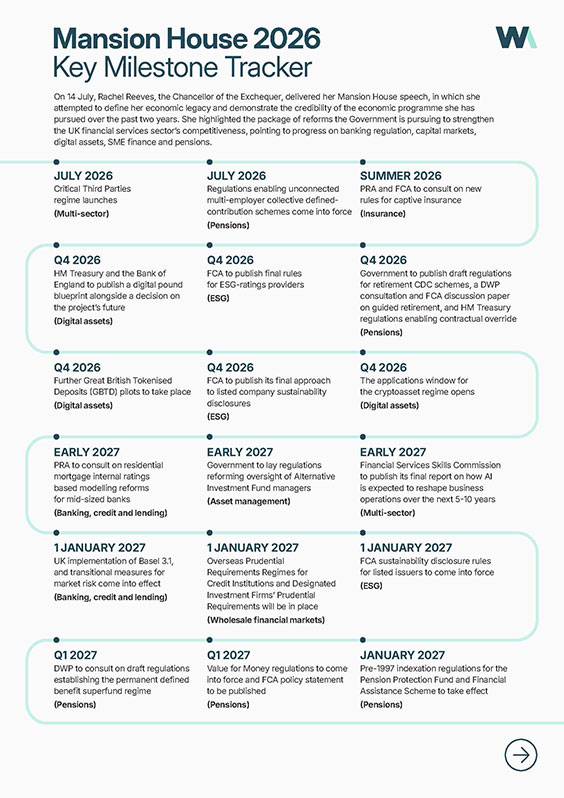
Mansion House Key Milestone Tracker
493.56 KB